Agentic Systems
Long-horizon reasoning, tool use, stateful interaction, and autonomous behaviour.
We build experiments that make model behaviour, reasoning, interaction, and learning easier to inspect.
As AI systems act across time, capability depends on more than model weights. Tools, state, feedback, reasoning processes, environments, and failure recovery become part of intelligence itself.
We study the machinery around intelligence.Long-horizon reasoning, tool use, stateful interaction, and autonomous behaviour.
Internal representations, mechanistic interpretability, model intervention, and behavioural analysis.
Search, symbolic constraints, structured reasoning, and verifiable computation.
Reinforcement-learning environments, synthetic experience, robotics, and adaptive learning systems.
Agent benchmarks, reward-hacking analysis, adversarial evaluations, and repeatable tests for unsafe optimisation and deceptive behaviour.
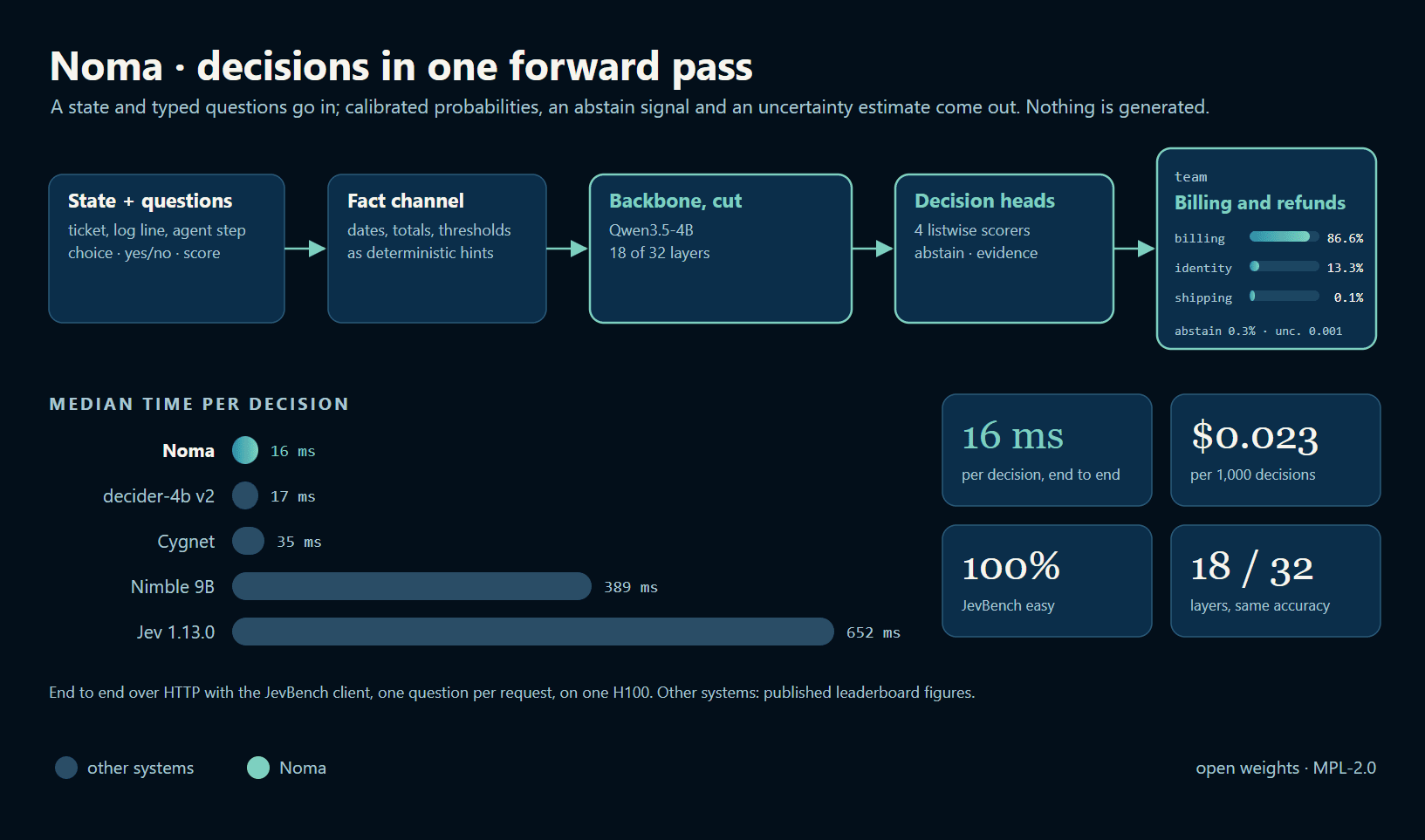
An open-weight decision model for agents and pipelines. It reads a state and typed questions and returns calibrated probabilities, an abstain signal, and an uncertainty estimate in one forward pass, in about 16 ms, with no generated text.
Paper: Noma: An Open System One Decision Model from a Sliced Decoder and Trained Heads. Atul Saxena and Divyanshi Sharma · Preprint, October 2026.